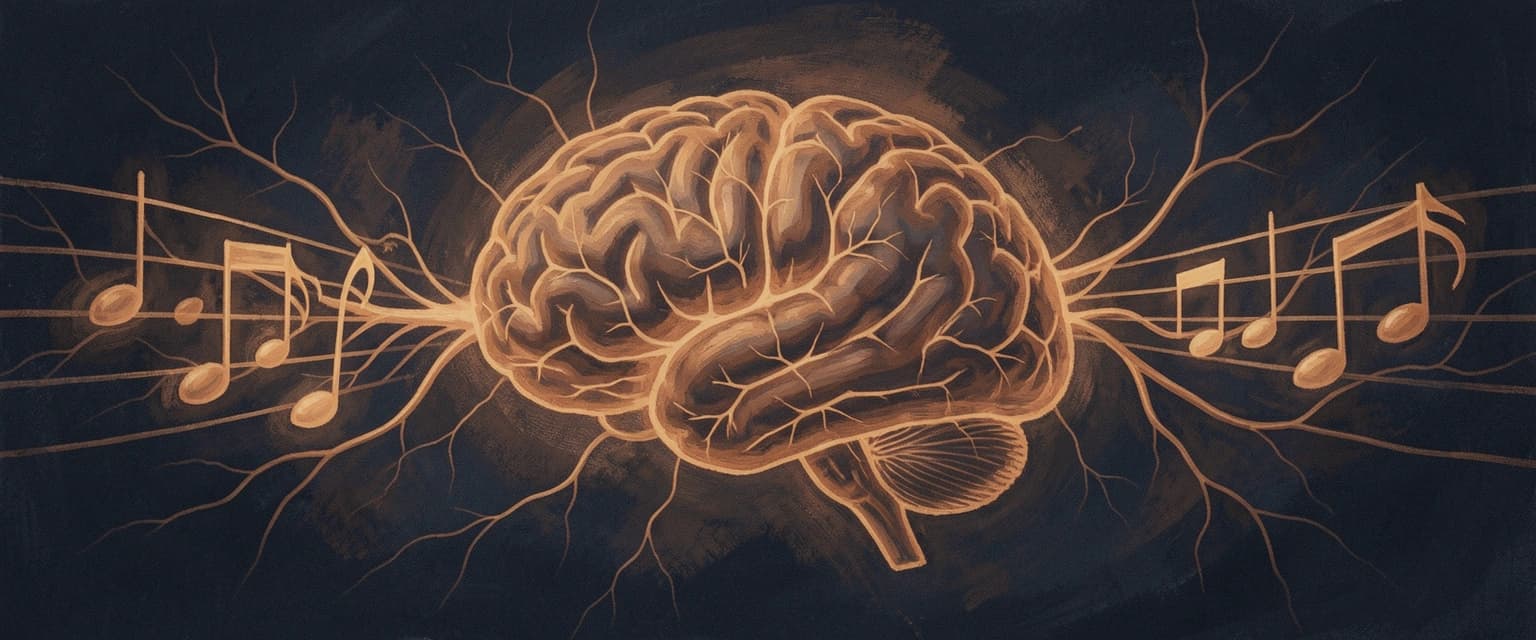
How Music Affects Your Brain During Sleep
Music does not merely help you fall asleep — research shows it can actively influence your brain waves during sleep, potentially enhancing memory consolidation and improving the overall quality of your rest.
Auditory-Cortical Entrainment
Your brain naturally produces rhythmic electrical patterns during sleep — delta waves during deep sleep, theta waves during light sleep, and faster activity during REM. When you listen to music with a strong rhythmic component, your brain's electrical activity can synchronize with the external rhythm, a process called auditory-cortical entrainment.
Slow, steady music at around 60 beats per minute — close to a resting heart rate — can encourage your brain to produce more slow-wave activity. This is significant because slow-wave sleep is the most restorative phase, when physical repair, immune function, and growth hormone release peak.
The Northwestern Memory Study
Researchers at Northwestern University demonstrated that sound stimuli timed to slow-wave oscillations during deep sleep enhanced memory consolidation. Participants who received synchronized auditory cues performed significantly better on memory tests the following day compared to control nights. While this study used targeted pulses rather than continuous music, it established that the sleeping brain is highly responsive to auditory input and that appropriately timed sound can enhance sleep's cognitive benefits.
Best Music Characteristics for Sleep
Not all music helps sleep equally. Research points to specific qualities that make music sleep-compatible:
- Tempo: 60 to 80 BPM, matching or slightly below resting heart rate.
- No lyrics: Vocal content activates language-processing centers, which can maintain wakefulness.
- Familiar music: Novel or surprising music demands active cognitive processing. Familiar pieces allow the brain to predict what comes next and disengage.
- Acoustic instruments: Piano, strings, harp, and guitar produce natural harmonic overtones that the brain processes more easily than synthesized sounds.
- Gradual dynamics: Avoid pieces with sudden volume changes or dramatic contrasts.
Practical Application
Start playing calming music 30 to 45 minutes before bed. Classical pieces — Chopin nocturnes, Debussy preludes, Bach's slower works — fit all the criteria for sleep-supportive music. As you become drowsy, your brain will naturally begin to entrain with the musical rhythm. Sorat features hundreds of sleep-appropriate classical and ambient tracks that you can play alone or layer with nature sounds for a multi-textured audio environment.